Argus
Data-collection application for a six-camera, hardware-synced GMSL2 rig on Jetson AGX Orin
- Maturity
- Not assessed
- Program
- P3 · Rigs and calibration
- Platform
- GPU workstation
- License
- Not specified
A recording rig has to say when its data cannot be trusted. Argus gates every recording on a preflight (frame sync, cameras, disk, temperature), records the sync verdict every second, and, if sync cannot be locked at boot, leaves the rig free-running with recording blocked rather than silently unsynchronised (README).
How it is put together.
Argus records a six-camera GMSL2 rig on an NVIDIA Jetson AGX Orin with hardware frame sync, together with the IMU and GNSS. Around the recorder it adds the operator workflow and quality assurance (preflight, a sync verdict logged every second, offline verification and a session report), checksum-verified offload, MCAP, nuScenes and KITTI export, a calibration studio, a smoothed 6-DoF trajectory, monocular 3D pre-labels with a CVAT review loop, search by meaning, privacy blurring and fleet operation. Neural-network and decoding work runs only after a drive, never during a recording.
- 1
Capture core
V4L2 capture with driver timestamps, NVENC H.265 and per-camera supervision
avrig/rig.py - 2
Sync and health
Sync verdict, preflight, image quality and host load
avrig/health.py - 3
Session store
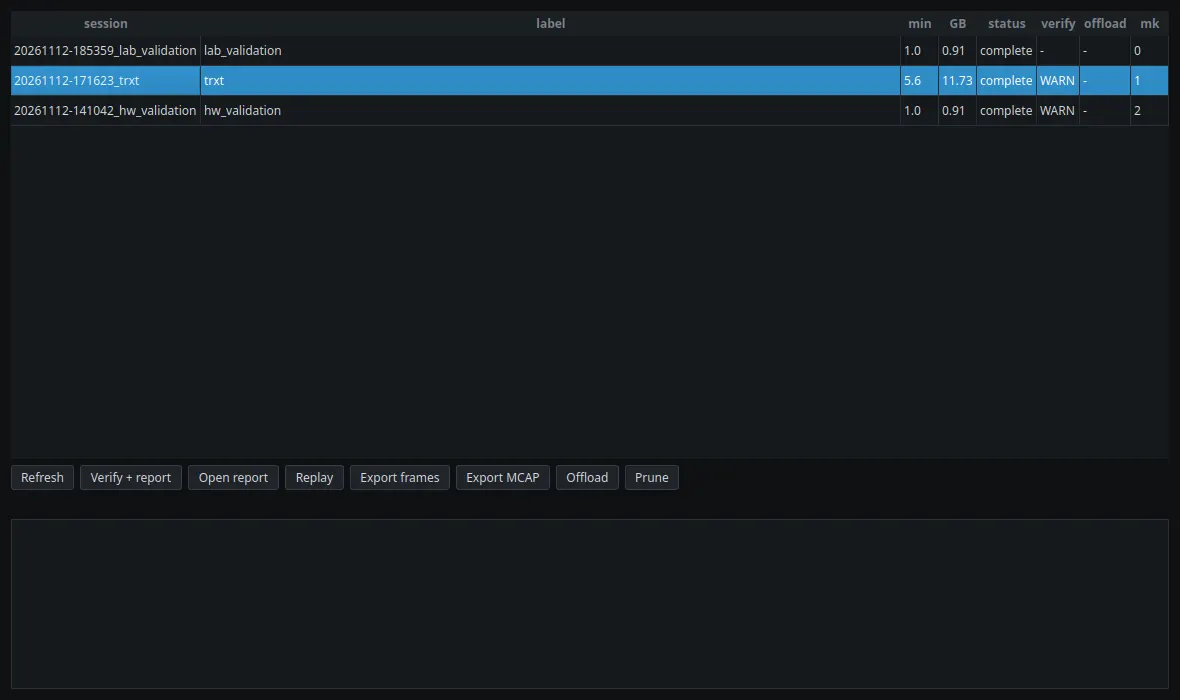
Segments, frames.csv timing authority, sensor logs and the manifest
avrig/session.py - 4
Verify and report
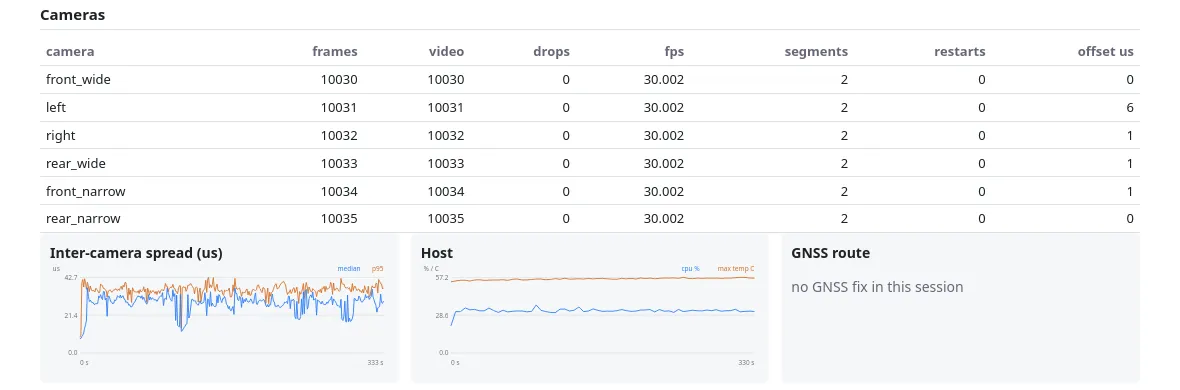
Offline frame accounting, alignment and the HTML report
avrig/verify.py - 5
Exporters
MCAP, nuScenes / KITTI, Nerfstudio and Foxglove replay
avrig/export.py - 6
Lab tools
Trajectory, calibration, 3D pre-labels, search and map layers
avrig/trajectory.py - 7
Operator GUI
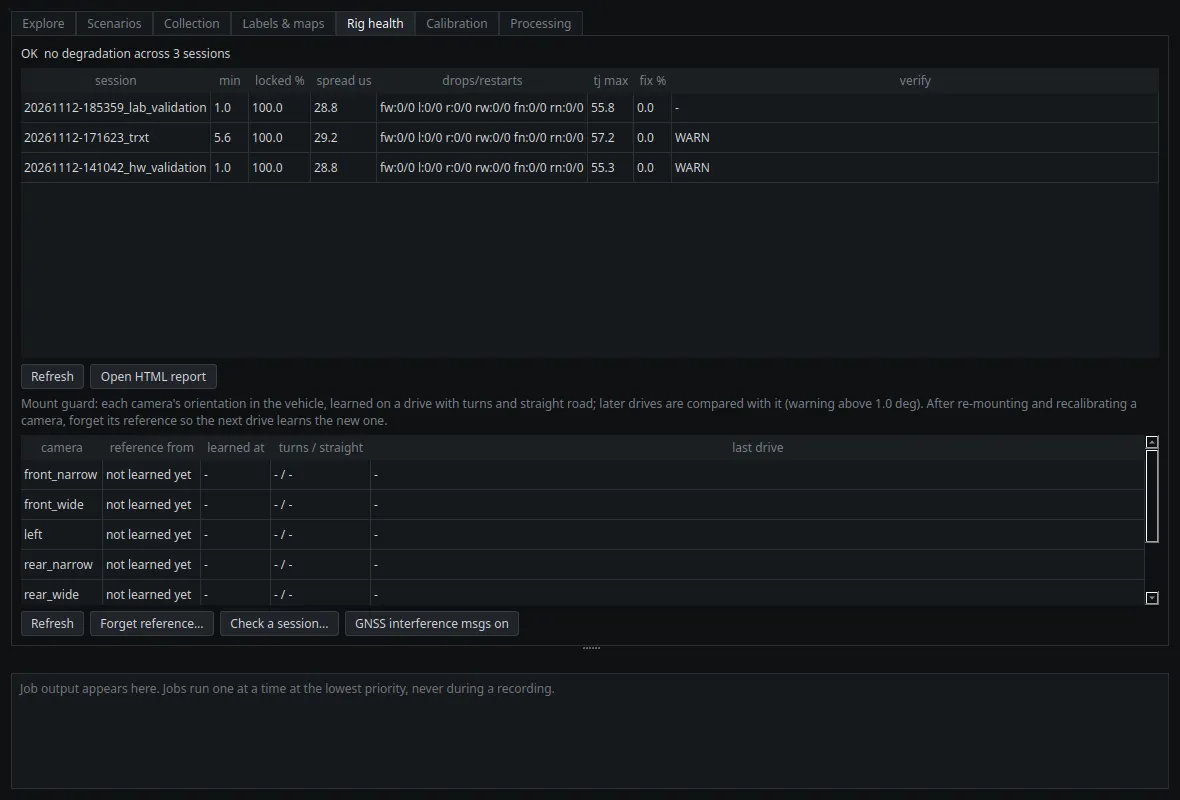
Live views, chip bar, sessions and the Lab window
avrig/gui.py
Specification.
- Capture
- Six GMSL2 cameras with hardware frame sync: direct V4L2 capture with driver timestamps, NVENC H.265, per-camera supervision; IMU and GNSS
- Sync verdict
- LOCKED below 100 µs spread, DEGRADED below 300 µs, then PARTIAL or FREE-RUN; logged every second, and a lost lock with sync on fails the session check
- Preflight and QA
- A failed preflight (sync off, missing camera, low disk, overheating) blocks recording; offline verify of frame counts, drops and alignment; an HTML report per session
- Offload
- SHA-256 while copying, re-hashed on read-back, a receipt on both sides; prune deletes only sessions whose verified copy still re-hashes
- Export
- Indexed MCAP with H.265 copied verbatim, nuScenes and KITTI datasets, Nerfstudio reconstruction export, Foxglove live view and replay
- Ground truth
- Raw GNSS for PPK, live RTK over NTRIP, a 15-state error-state Kalman filter with an RTS smoother, visual speed through GNSS outages
- Calibration studio
- Printable ChArUco board, fisheye and pinhole intrinsics, extrinsics from hardware-synced frame pairs, Kalibr export
- Lab tools
- Search by meaning (CLIP), rarity-weighted curation, monocular 3D pre-labels with a CVAT review loop, map layers, face and plate blurring
- Fleet
- Hands-free recording started by GNSS speed, a depot offload timer and a read-only fleet dashboard
- Runs on
- Runs on the rig's NVIDIA Jetson AGX Orin 64 GB: V4L2 capture of six GMSL2 cameras, NVENC / NVDEC and TensorRT
From the app.
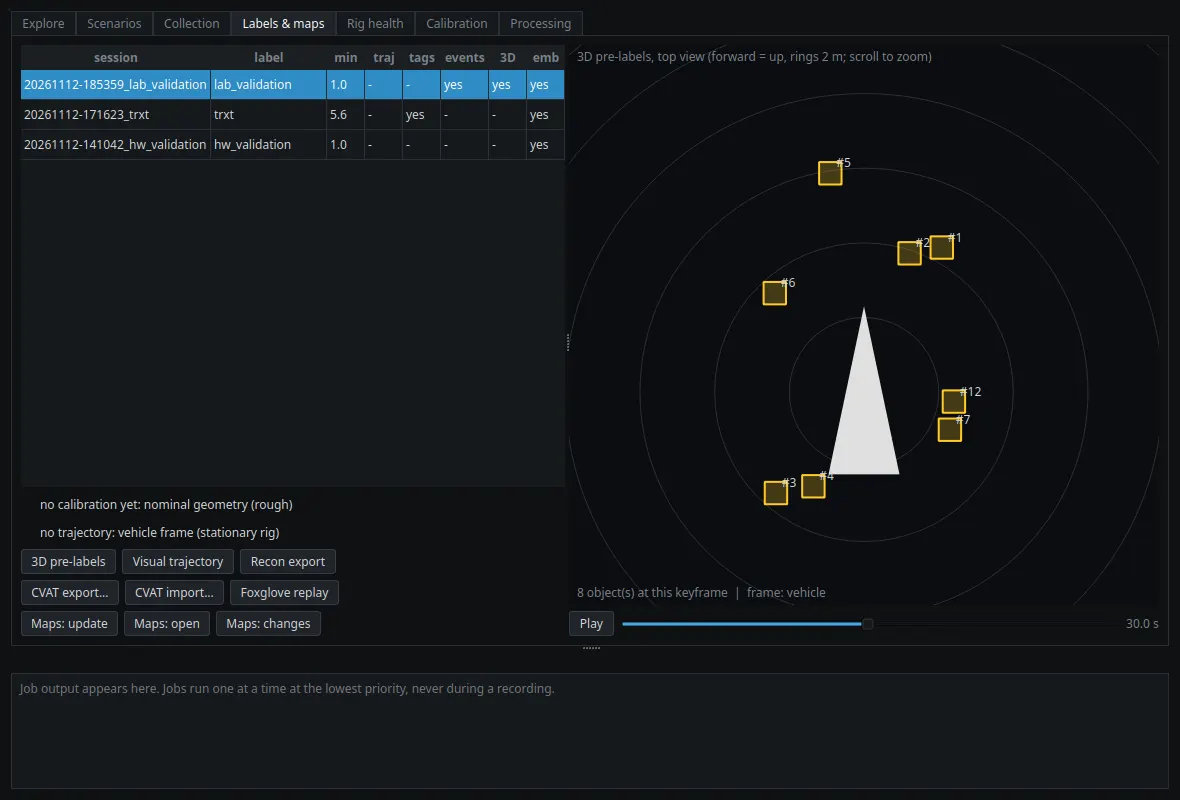
Notes.
Measured on the bench
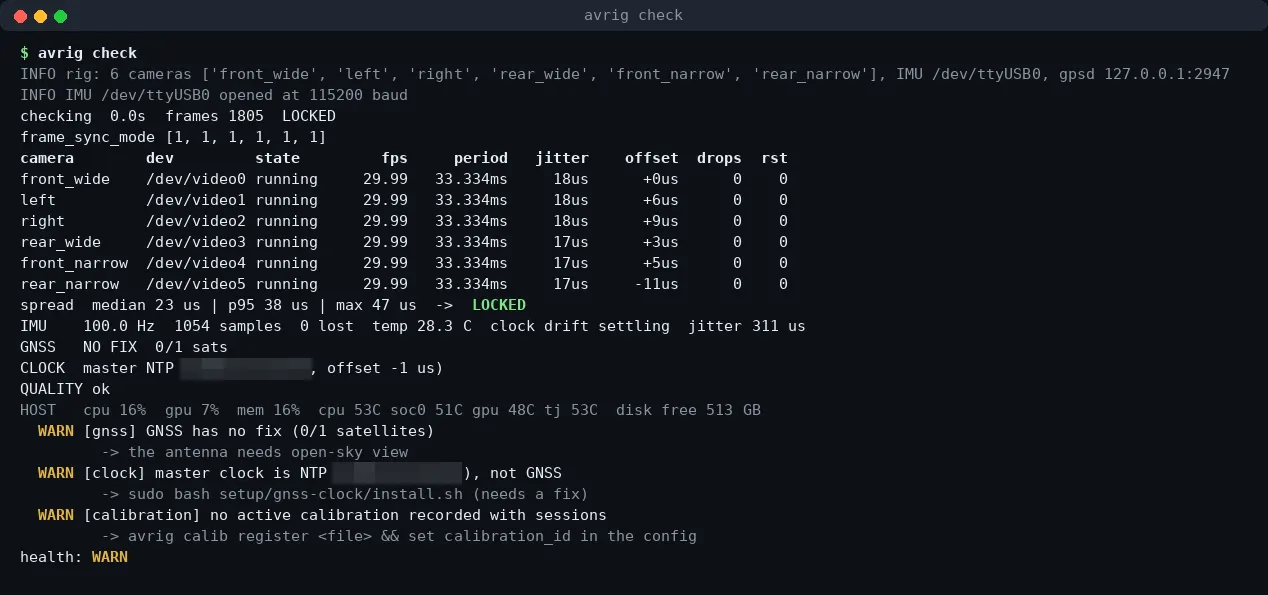
The README reports the rig on the bench on 12 November 2026, with frame sync from the deserializer’s internal trigger and the GNSS antenna indoors, so without a fix. In a 15 s check the median spread between the six cameras was 29 µs; a 61 s recording, checked offline frame by frame, had 0 frames dropped and a median alignment of 29 µs. In a 4-minute soak, sync was LOCKED for 234 s of 235 s.
| Quantity | Value | Conditions | Basis |
|---|---|---|---|
| Inter-camera frame spread, median (15 s check) | 29 µs | on the bench; frame sync from the deserializer's internal trigger (SW2 = internal); GNSS antenna indoors, no fix; `avrig check`, 15 s, all six cameras at 29.99 fps | Reported 2026-11-12 |
| Inter-camera frame spread, 95th percentile (15 s check) | 36 µs | on the bench; frame sync from the deserializer's internal trigger (SW2 = internal); GNSS antenna indoors, no fix; `avrig check`, 15 s | Reported 2026-11-12 |
| Frame alignment across the six cameras, median (61 s recording) | 29 µs | on the bench; frame sync from the deserializer's internal trigger (SW2 = internal); GNSS antenna indoors, no fix; 61 s recording checked offline with `verify` | Reported 2026-11-12 |
| Frame alignment across the six cameras, 95th percentile (61 s recording) | 38 µs | on the bench; frame sync from the deserializer's internal trigger (SW2 = internal); GNSS antenna indoors, no fix; 61 s recording checked offline with `verify` | Reported 2026-11-12 |
| Dropped frames in a 61 s recording, all six cameras | 0 frames | on the bench; frame sync from the deserializer's internal trigger (SW2 = internal); GNSS antenna indoors, no fix; frames.csv matched the video frames on all six | Reported 2026-11-12 |
| Seconds with frame sync LOCKED in a 4-minute soak | 234 s of 235 s | on the bench; frame sync from the deserializer's internal trigger (SW2 = internal); GNSS antenna indoors, no fix; 0 drops, 0 restarts, CPU 28 %, 54 to 57 °C | Reported 2026-11-12 |
| Recorder CPU, six cameras recording (30 s) | 180 % of one core | on the bench; frame sync from the deserializer's internal trigger (SW2 = internal); GNSS antenna indoors, no fix; out of 12 cores; the earlier recorder (rigcap) measured 177 % in the same test | Reported 2026-11-12 |
| Time to frames after an injected camera stall | 2.1, 2.4 s | on the bench; frame sync from the deserializer's internal trigger (SW2 = internal); GNSS antenna indoors, no fix; three injected stalls, measured from the last good frame; the other five cameras untouched; the earlier recorder took 4.6 s | Reported 2026-11-12 |
| Object detector latency on the Orin GPU (YOLOX-s, TensorRT) | 3.2 ms per 640 px inference | on the bench; frame sync from the deserializer's internal trigger (SW2 = internal); GNSS antenna indoors, no fix; plates 5.5 ms, faces about 3 ms | Reported 2026-11-12 |
| Tests passed | 102 tests | unit tests and simulated cameras on real GStreamer, NVENC and the GPU, on the rig | Reported 2026-11-12 |
Accuracy on simulated data
The trajectory, calibration and GNSS-outage figures come from simulated data with exact truth; the README states that there has been no real drive or printed calibration board yet.
| Quantity | Value | Conditions | Basis |
|---|---|---|---|
| Trajectory horizontal error, RMS (simulated 200 s drive) | 0.37, 0.42 m | simulated data with exact truth; no real drive or printed board yet; 1 Hz GNSS with 1.5 m RMS error | Reported 2026-11-12 |
| Camera-to-camera extrinsics, rotation error (simulated) | 0.03 ° | simulated data with exact truth; no real drive or printed board yet; pinhole and fisheye cameras 35° apart, rendered at known poses | Reported 2026-11-12 |
| Camera-to-camera extrinsics, translation error (simulated) | 1.3 mm | simulated data with exact truth; no real drive or printed board yet; pinhole and fisheye cameras 35° apart, rendered at known poses | Reported 2026-11-12 |
| Max position error through a 120 s GNSS outage, IMU only (simulated) | 5.2 m | simulated data with exact truth; no real drive or printed board yet; 1.27 km outage with a drifting accelerometer bias | Reported 2026-11-12 |
| Max position error through a 120 s GNSS outage, IMU and visual speed (simulated) | 0.57 m | simulated data with exact truth; no real drive or printed board yet; 1.27 km outage with a drifting accelerometer bias; visual speed from a rendered road | Reported 2026-11-12 |
Not yet verified on hardware
The README lists what is implemented and tested but not yet run in a vehicle: the GNSS master clock and GNSS time marks of the camera trigger, IMU SyncIn, CAN logging, live RTK and PPK, the trajectory, the calibration studio with a printed board, plate blurring on road traffic, hands-free recording, the camera-mount guard, visual speed, 3D pre-labels, map layers and the reconstruction export.
The rig
Argus records the same six-camera rig as the Data Collection Rig, as the author confirms. It is derived from an earlier recorder for that rig and keeps its capture core. On the bench its sessions held hardware sync, while the vehicle session recorded earlier with the previous capture software, shown on the Data Collection Rig page, was free-running; the two runs differ in software, date and setting.
An instrument of P3.
Can a data-collection vehicle's sensor rig and bus signals be specified, calibrated and checked against the plan from evidence, before and after the hardware is fitted?
Instrument · Validated in simulationVantageSensor rig planner for autonomous-driving data collection
Instrument · PrototypeCanLabA desktop workstation for reverse-engineering a CAN bus