Sentigon V2
Turns ordinary IP camera video into structured, reasoned and verified security events
- Maturity
- Not assessed
- Program
- P5 · Security vision
- Platform
- GPU workstation
- License
- MIT
Instead of leaving an operator to watch a wall of feeds, the system turns camera video into detected, grouped, risk-scored and VLM-verified incidents that drive response playbooks.
How it is put together.
Sentigon V2 is a computer-vision layer on top of IP cameras that detects objects and behaviours, groups them into incidents, scores each one, asks a vision-language model to confirm or dismiss it, and runs a response playbook. It is built as an event-driven monorepo of eleven small Python services that exchange typed messages over a Kafka-compatible bus (Redpanda), with a Next.js operator console. The whole stack runs on one workstation with one GPU; the heavier VLM tier can be pointed at a rented cloud GPU through configuration.
- 1
Ingest
RTSP capture, MediaMTX relay, segmented recording, pre-roll ring buffer, health
services/ingest/ - 2
Perception
Detection, tracking, ReID embeddings, ANPR, pose/fall; DeepStream path for dGPU
services/perception/ - 3
Context
Behaviour signatures, learned anomaly baselines, access/video fusion, dedup
services/context/ - 4
Reason
VLM verification of candidate incidents, natural-language alert evaluation
services/reason/ - 5
Notify
SOP response playbooks
services/notify/ - 6
API and console
REST API and Next.js operator console
services/api/, web/ - 7
Shared library
ORM models, message schemas, bus helpers, storage, evidence hash-chain, risk scoring, TTS
services/common/
Specification.
- Ingest
- RTSP and ONVIF cameras via MediaMTX relay, WebRTC/HLS playback, segmented recording to MinIO, pre-roll ring buffer
- Perception
- YOLO26 detection, ByteTrack tracking, OSNet-AIN ReID, ANPR (YOLO plate detector + EasyOCR), YOLO pose and fall
- Behaviour rules
- Intrusion, loitering, tailgating, crowd formation, running, speeding, zone exclusion, access-plus-video composites
- Anomaly and triage
- Per-zone baselines learned online; composite risk score with P1–P4 bands; repeat detections grouped into one incident
- VLM verification
- Qwen2.5-VL 7B via Ollama locally, or Qwen3-VL via vLLM; verdict and rationale from pre/post-roll frames
- Response
- SOP playbooks: escalate, open case, email, webhook, web-push, Piper TTS talk-down
- Forensics and search
- Multi-camera incident reconstruction; semantic, visual and ReID search over Qdrant
- Privacy
- Face-blurred snapshots, salted-and-hashed plate values, tamper-evident evidence hash-chain
- Runs on
- Perception defaults to CUDA (services/perception/sentigon_perception/detector.py) with torch pinned to CUDA 12.8 wheels (pyproject.toml); README says the stack runs on a workstation with one GPU and a local 7B VLM via Ollama; docker-compose.gpu.yml adds vLLM and Triton with NVIDIA GPU reservations.
From the app.
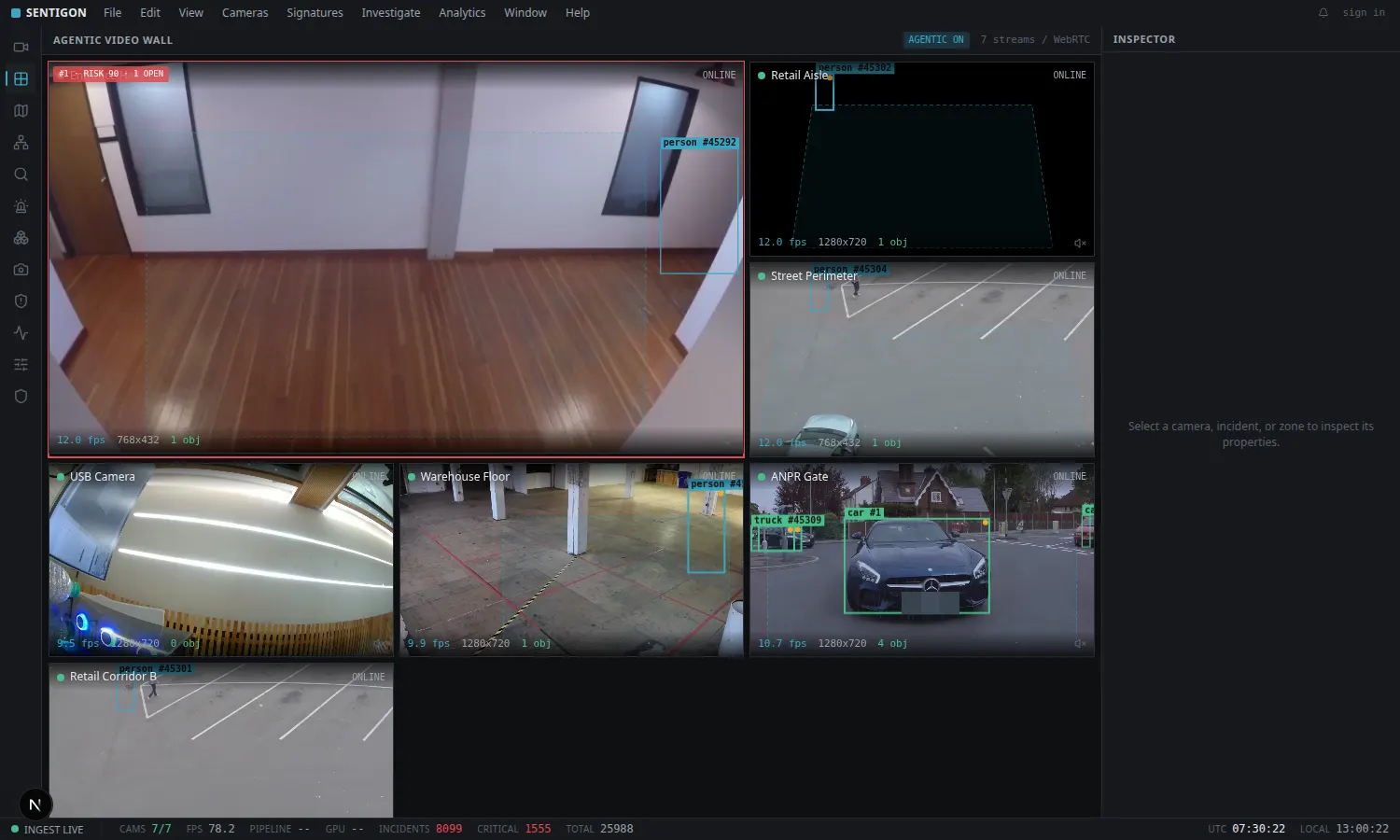
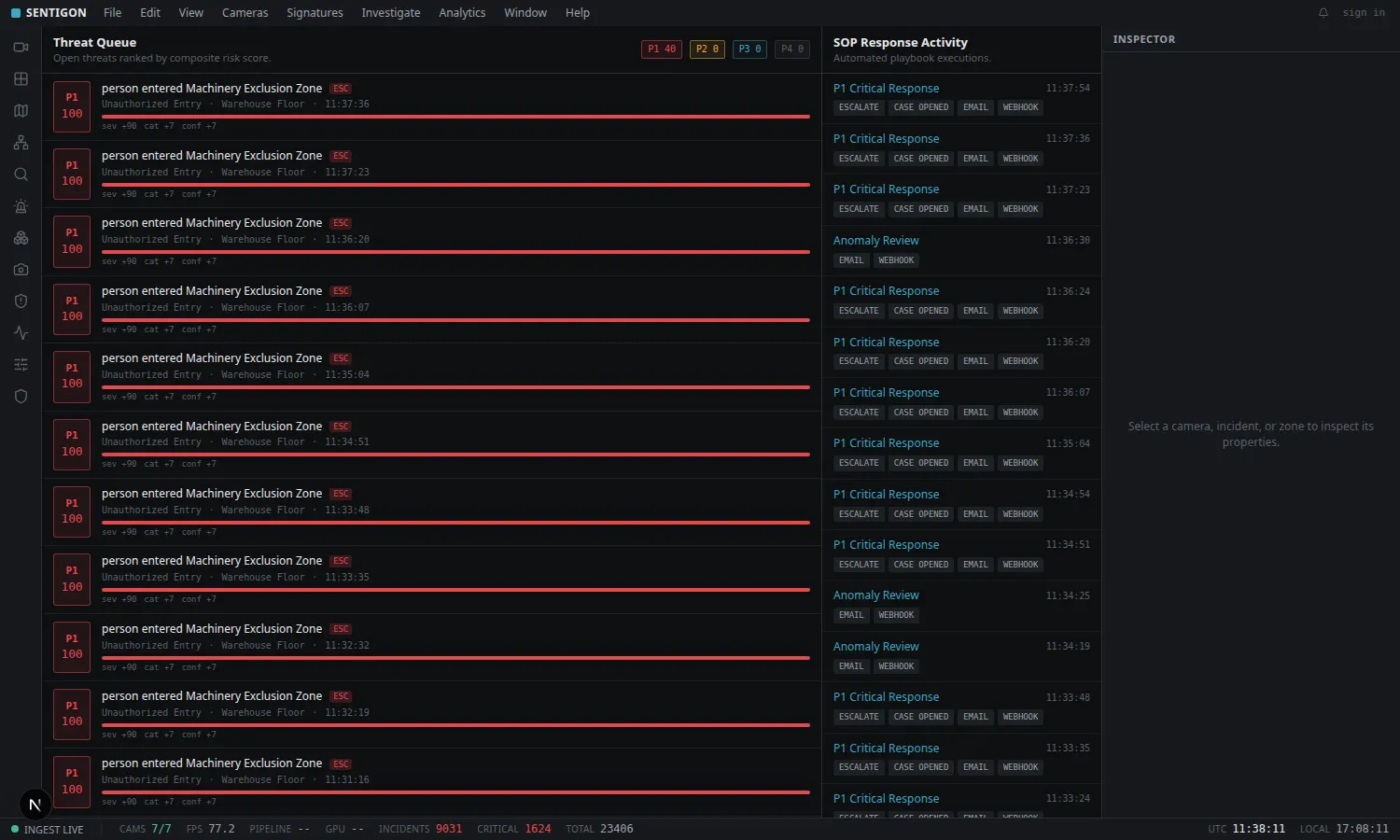
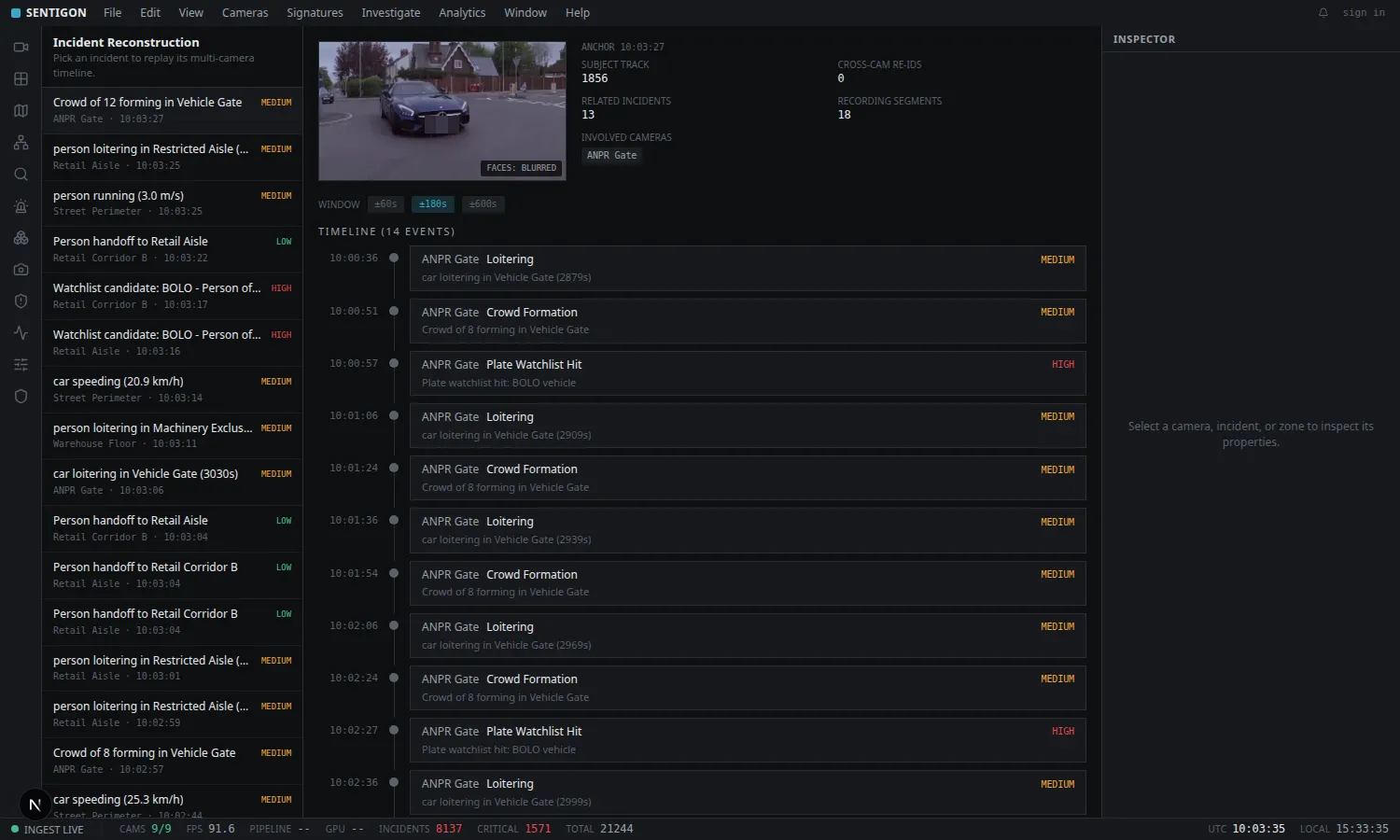
An instrument of P5.
Can ordinary cameras be turned into verified, prioritised incidents on local hardware, with each alert checked by a second model before it reaches an operator?
InstrumentSentigon EdgeComputer-vision security system that runs on a single NVIDIA Jetson AGX Orin
InstrumentSentigon ForgeData-acquisition and model-training platform for security and safety computer vision